NFPA 101 Crowd Manager Requirements: Ratios, Duties & Code Compliance
A technical guide to NFPA 101 crowd manager ratios, life safety inspection duties, emergency egress rules, and US assembly occupancy enforcement.
Key Takeaways at a Glance
Martyn's Law Aligned
Covers UK Section 12 regulations & crowd capacity guidelines.
Verifiable ID Credentials
Instant certificate verification for crew CVs and employers.
- 1.The NFPA 101 Crowd Manager Ratio: Core Requirements
- 2.Core Operational Duties: What Crowd Managers Must Actually Do
- 3.Required Training Curriculum under NFPA 101
- 4.OSHA General Duty Clause: Employer Liability for Crowd Crushes
- 5.State-by-State Adoption: Why You Must Confirm with Your Local AHJ
- 6.Actionable Steps for Venue Directors & Event Planners
In the United States, venue life safety regulations place direct legal responsibility on facility operators to provide trained crowd management personnel during public assemblies. Unlike general security guards or ticket takers, a designated crowd manager holds a specific statutory mandate under the National Fire Protection Association (NFPA) life safety codes: maintaining unobstructed egress routes, conducting pre-event life safety inspections, monitoring crowd dynamics, and initiating orderly evacuation during an emergency.
The requirement for trained crowd managers traces directly back to one of the deadliest assembly disasters in modern American history: the February 20, 2003 Station nightclub fire in West Warwick, Rhode Island, which claimed 100 lives. In response to post-incident investigations revealing locked exit doors, inadequate egress capacity, and a complete absence of coordinated crowd supervision, the NFPA Standards Council issued emergency Tentative Interim Amendments (TIAs) mandating crowd manager ratios across assembly occupancies. These provisions now form an established pillar of NFPA 101: Life Safety Code (2024 ed.).
The NFPA 101 Crowd Manager Ratio: Core Requirements
The operational baseline for crowd management staffing is defined in NFPA 101: Life Safety Code (2024 ed.), Chapter 12 (New Assembly Occupancies) and Chapter 13 (Existing Assembly Occupancies):
- Baseline Mandate: Under NFPA 101 (2024 ed.), §12.7.6.1 and §13.7.6.1, all assembly occupancies must be provided with a minimum of one trained crowd manager or crowd manager supervisor.
- The 1:250 Occupant Ratio: Where the occupant load exceeds 250, additional trained crowd managers or crowd manager supervisors must be provided at a ratio of one crowd manager for every 250 occupants (or portion thereof).
In practice, this means an assembly occupancy with an occupant load of up to 250 persons requires at least one crowd manager; a venue with 251 to 500 occupants requires at least two; 501 to 750 requires at least three; and 751 to 1,000 requires at least four. You can calculate your exact required staffing breakdown across venue areas using our interactive Crowd Staffing Ratio Calculator.
Statutory Exceptions under NFPA 101 (2024 ed.)
The 2024 edition of NFPA 101 permits two specific exemptions to the standard staffing ratio under NFPA 101 (2024 ed.), §12.7.6.1:
- Houses of Religious Worship: The requirement for crowd managers does not apply to assembly occupancies used exclusively for religious worship with an occupant load not exceeding 500 (NFPA 101 (2024 ed.), §12.7.6.1(1)).
- Authority Having Jurisdiction (AHJ) Reduction: The ratio of trained crowd managers to occupants is permitted to be reduced where, in the professional opinion of the local Authority Having Jurisdiction (AHJ), the existence of an approved, supervised automatic sprinkler system and the low-hazard nature of the event warrant a modification (NFPA 101 (2024 ed.), §12.7.6.1(2)).
Core Operational Duties: What Crowd Managers Must Actually Do
Under NFPA 101: Life Safety Code (2024 ed.), §12.7.6.2 and §13.7.6.2, the crowd manager is not a passive observer or private security bouncer. They are trained life safety specialists tasked with active operational obligations before, during, and after an event:
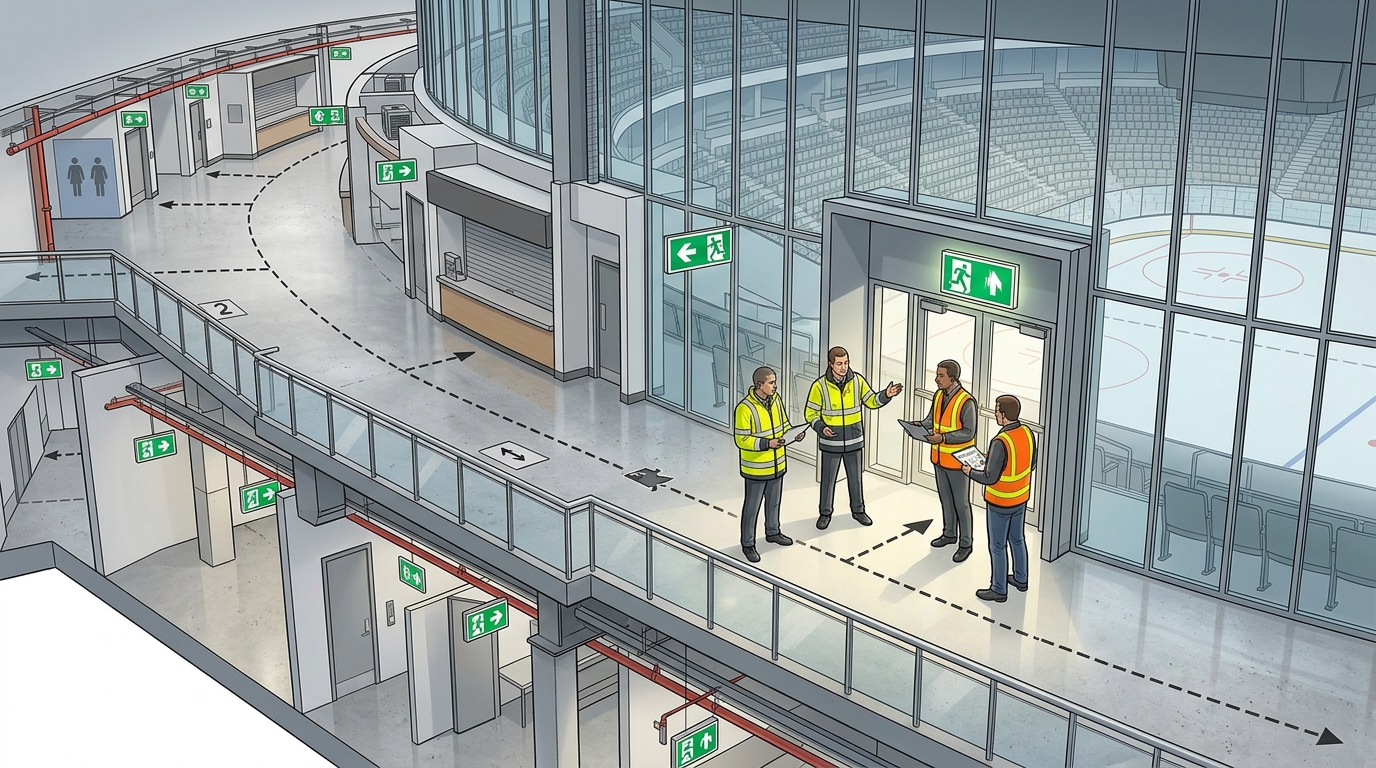
- Pre-Event Egress Inspection: In accordance with NFPA 101 (2024 ed.), §12.7.6.4, crowd managers must conduct an inspection of all means of egress prior to opening doors to the public. This inspection must confirm that all exit doors are unlocked, unblocked by equipment or curtains, unobstructed by temporary vendor booths, and swinging freely in the direction of exit travel with functional panic hardware.
- Emergency Lighting and Signage Verification: Confirming that all illuminated EXIT signs, direction indicators, and emergency backup battery packs are fully operational.
- Maintaining Continuous Egress: Ensuring that aisles, passageways, stairwells, and vomitories remain free from congestion, standing crowds, or loose seating throughout the event. You can verify whether your venue exits meet required discharge rates using our Emergency Evacuation Calculator.
- Monitoring Density and Bottlenecks: Identifying crowd surges, high-density clustering (above 4 persons per square metre), and vocal or physical signs of distress early, before crush pressures develop.
- Emergency Response and Evacuation Management: In the event of fire, structural alert, or threat, crowd managers must direct patrons toward designated exit discharges, prevent crowd counterflow, guide occupants away from primary entrances toward secondary exits, and liaise directly with first responders.
Required Training Curriculum under NFPA 101
Merely assigning venue staff or ushers to crowd management without verifiable training violates the standard. Under NFPA 101: Life Safety Code (2024 ed.), §12.7.6.3 and §13.7.6.3, training must be documented and cover approved competencies:
- Understanding crowd behavior, panic dynamics, and the psychological factors that govern group egress (explored in our Crowd Psychology resources).
- Facility-specific emergency action plans, egress maps, and emergency announcement scripts.
- Fire safety systems, alarm verification, and fire extinguisher deployment basics.
- Techniques for managing crowd movement at ingress turnstiles, concourse bottlenecks, and exit doors.
Venue operators can train their frontline stewards and supervisors through our comprehensive online Crowd Safety Certificate and manage staff certifications through our dedicated Team Portal.
OSHA General Duty Clause: Employer Liability for Crowd Crushes
In addition to municipal fire codes, crowd safety in the United States intersects with federal workplace safety law enforced by the Occupational Safety and Health Administration (OSHA). Under Section 5(a)(1) of the Occupational Safety and Health Act of 1970 (commonly known as the General Duty Clause), every employer has a legal duty to furnish to each worker employment and a place of employment free from recognized hazards that are causing or are likely to cause death or serious physical harm.
Following high-profile crowd surge incidents that injured or killed retail and event workers (such as the 2008 Long Island Black Friday crowd crush), OSHA issued formal enforcement guidance clarifying that crowd-related physical hazards—including crowd crush forces, uncontrolled queue surges, and blocked exit routes—are recognized industry hazards. When venue operators fail to train crowd management personnel, establish physical queue barriers, or meter ingress rates, they expose themselves to substantial federal citations and statutory liability under Section 5(a)(1).
State-by-State Adoption: Why You Must Confirm with Your Local AHJ
One of the most critical legal realities in American venue management is that there is no single federal building or fire code. The NFPA publishes NFPA 101 as a model consensus standard, but it carries no force of law until formally adopted by a state legislature, county commission, or municipal government.
Across the United States, code adoption varies significantly:
- Model Code Variation: Some jurisdictions adopt NFPA 101 directly statewide as their primary life safety code. Other jurisdictions adopt the International Fire Code (IFC), which incorporates crowd manager mandates under Section 403.12.3 in recent editions, or the International Building Code (IBC) with local state amendments.
- Edition Lags: States and cities rarely update their codes in lockstep with national release cycles. A jurisdiction may currently enforce the 2015, 2018, or 2021 edition of NFPA 101 rather than the 2024 edition. While the 1:250 ratio has remained stable across recent editions, specific administrative reporting and training approval rules can vary.
- Local Threshold Amendments: Local municipalities frequently adopt amendments that lower the occupant threshold. For example, some cities require trained crowd managers for any establishment serving alcohol with an occupant load of 100 or more, rather than the standard 250 baseline.
Because statutory requirements are determined at the state and municipal levels, venue directors, event producers, and safety coordinators must never assume national defaults without local confirmation. Always consult your State Fire Marshal's office and your local Authority Having Jurisdiction (AHJ)—typically the municipal fire prevention bureau or building official—to verify the exact code edition, local amendments, and accredited training programs required for your facility.
Actionable Steps for Venue Directors & Event Planners
To ensure full compliance and safeguard attendee life safety ahead of your next event:
- Audit Your Permitted Occupant Load: Confirm your official certificate of occupancy against your actual event layout using our Crowd Density Calculator.
- Calculate Required Staffing Ratios: Apply the 1:250 baseline (at least one crowd manager, plus one more for every 250 occupants) and confirm whether local AHJ rules mandate additional staffing for standing general-admission areas.
- Verify Documented Certification: Ensure every deployed crowd manager and supervisor holds a verified, non-expired certificate of training.
- Execute Pre-Doors Egress Inspections: Complete a physical walk-through 60 to 90 minutes before public entry, signing off on unlocked exits and illuminated signage per NFPA 101 (2024 ed.), §12.7.6.4.
For a detailed breakdown of US life safety statutes and historical precedents, explore our United States Regulations Profile and review lessons from past events in our historical analysis of The Who 1979 Cincinnati concert crush.
Ready to get your crowd safety certificate?
Takes only 15 minutes. Instantly verifiable certificate. Aligned with Martyn's Law and international crowd safety standards.