Front-of-Stage Barrier Design: Pit Configurations, Pressure Relief, and Crowd Extrication Protocols
An engineering and operational guide to concert barrier loads, pit geometry, secondary wave barriers, and steward extrication protocols under IStructE and Purple Guide standards.
Key Takeaways at a Glance
Martyn's Law Aligned
Covers UK Section 12 regulations & crowd capacity guidelines.
Verifiable ID Credentials
Instant certificate verification for crew CVs and employers.
- 1.The Physics of Front-of-Stage Crowd Surges
- 2.Structural Load Standards: IStructE Requirements
- 3.Pit Geometry: Dimensions for Safe Operation
- 4.Barrier Geometry: Straight vs Curved vs D-Barrier Layouts
- 5.Secondary Delay (Wave-Breaker) Barriers
- 6.Frontline Extrication Protocols and the Show-Stop Procedure
- 7.Case Studies in Barrier Failure: Roskilde 2000 & Astroworld 2021
- 8.Ensure Your Event Crew Understands Pit Safety
The front-of-stage barrier line is universally recognized by crowd safety engineers as the single highest-risk zone in live entertainment. In standing general-admission environments, enthusiasm, visual focus, and acoustic pressure combine to funnel thousands of attendees toward a single focal point. When surges occur, the crowd behaves like a fluid, transmitting lateral physical forces that can exceed thousands of newtons against the barrier rail.
A properly engineered barrier system does not merely hold back a crowd; it creates an operational life-support zone. This technical guide examines front-of-stage barrier design, pit dimensions, structural load testing benchmarks from the Institution of Structural Engineers (IStructE, 4th ed., 2017), and steward extrication protocols established in the UK Purple Guide and HSE HSG195.
The Physics of Front-of-Stage Crowd Surges
In standing festival crowds, individuals occupy between 0.2 m² and 0.5 m² of ground space. As density climbs past 4 persons per square metre, physical contact between adjacent bodies becomes continuous. In this state, forces are no longer generated by individual intentional pushing; instead, shockwaves propagate through the crowd as momentum transfers from the rear toward the front.
Empirical measurements recorded during major concert incidents demonstrate that horizontal crowd pressures at the barrier handrail can reach 4.0 kN to 4.5 kN per linear metre (kilonewtons per metre). At these pressures, steel railings can bend, and attendees pinned against the barrier suffer compressive asphyxia—where pressure on the chest cavity prevents the lungs from expanding, causing unconsciousness within two to four minutes.
Structural Load Standards: IStructE Requirements
Temporary barriers used at public events must never be improvised. The recognized benchmark for temporary event structures—the Institution of Structural Engineers Temporary Demountable Structures: Guidance on procurement, design and use (4th ed., 2017, Section 8.3)—specifies mandatory horizontal design loads:
- High-Energy Standing Music Events: Front-of-stage barriers must be structurally rated and tested to withstand a minimum horizontal working load of 5.0 kN/m applied at the top rail (typically 1.10 m to 1.20 m above the floor baseplate).
- Low-Energy or Calmer Assembly Audiences: Barriers may be rated to a lower threshold of 3.0 kN/m where historical artist dynamics, audience demographics, and venue layout present minimal surge risk.
- Baseplate Self-Weight Anchoring: Proprietary barrier units (such as certified Mojo-style aluminum barrier frames) feature an extended front footplate. The weight of the frontline attendees standing directly on the plate mechanically counteracts the forward overturning moment, anchoring the barrier firmly to the ground without requiring floor bolts.
Pit Geometry: Dimensions for Safe Operation
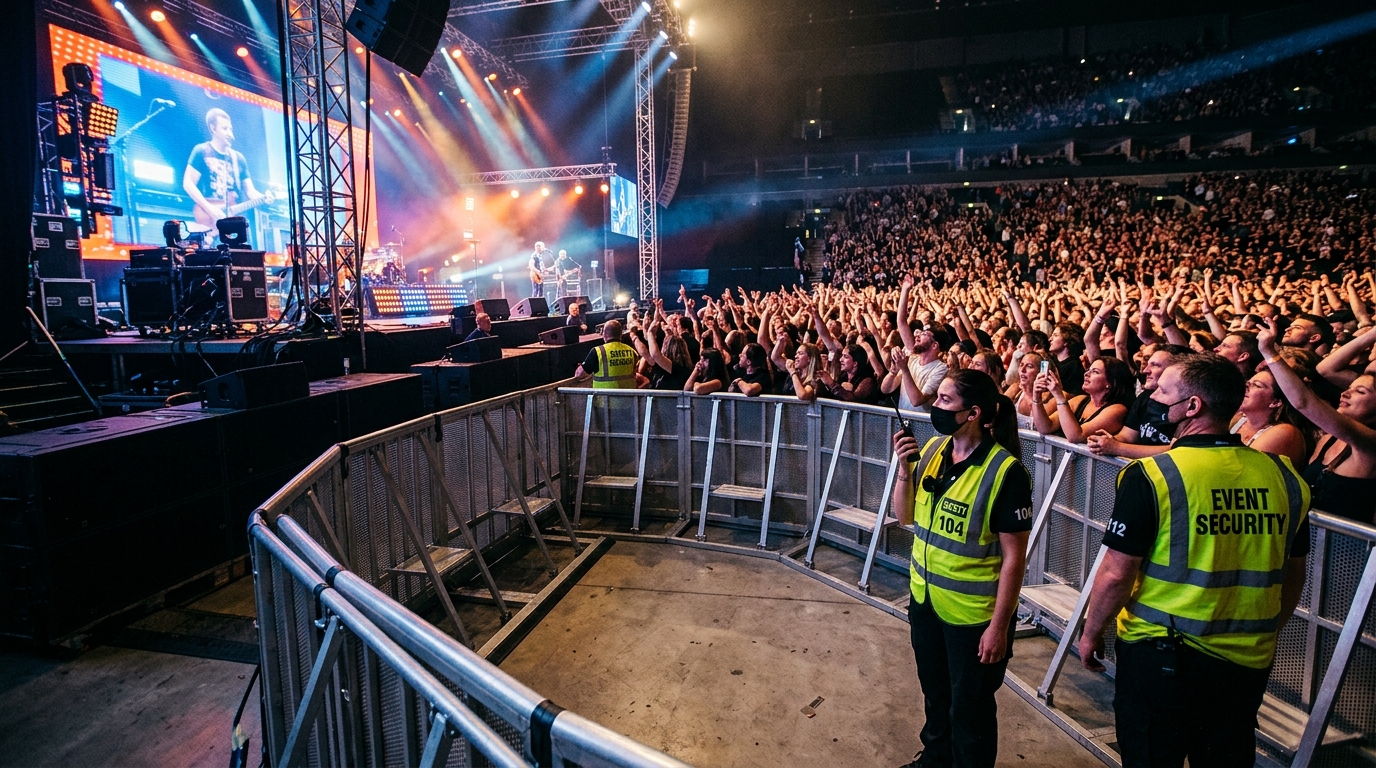
The space between the rear of the barrier and the front edge of the stage—known as the “security pit”—must be treated as a dedicated medical and rescue corridor. The UK Events Industry Forum Purple Guide (Chapter on Barriers) and HSE guidance (HSG195) establish critical spatial parameters:
- Minimum Clear Pit Width: The pit must maintain a continuous, unobstructed depth of 1.20 to 1.50 metres. This provides sufficient room for stewards to maneuver, catch crowd-surfers, and wheel medical stretchers without colliding with stage subwoofers or lighting trusses.
- Raised Steward Platforms (Footboards): Certified front barriers feature an integrated rear step positioned approximately 0.35 m to 0.45 m above ground level. This platform provides stewards with an elevated vantage point to scan the crowd three to four rows back and provides the ergonomic leverage necessary to lift distressed patrons over the 1.20 m top rail.
- Egress Gates and Lateral Exits: The pit must have wide, unblocked exit paths leading out to stage left and stage right directly into backstage medical triage areas. These paths must never be blocked by audio snake cables or production road cases.
Barrier Geometry: Straight vs Curved vs D-Barrier Layouts
The physical configuration of the barrier line fundamentally determines how crowd forces distribute:
- Straight Linear Barrier: Easy to install, but creates maximum central pressure. Force vectors from both stage-left and stage-right audience sectors converge squarely into the center, concentrating maximum compressive stress on attendees directly in front of the lead performer.
- Curved (Convex) Barrier: Curved outward toward the audience, this configuration deflects crowd momentum toward the sides. When an audience surges forward, the curved profile naturally channels people along the barrier face toward outer flanks, dispersing peak focal pressure.
- Center Thrust (Catwalk) Barriers: When an artist catwalk extends into the crowd, barriers run perpendicular to the main stage. Crucially, any 90-degree internal corner forms a lethal wedge trap where attendees can be pinned against two converging walls. Internal corners must always be blunted with 45-degree corner sections to eliminate 90-degree pinch points.
Secondary Delay (Wave-Breaker) Barriers
In large outdoor festival grounds where the standing floor extends more than 25 to 30 metres back from the stage, a single front barrier is insufficient. In an unbroken 60-metre standing field, the sheer mass of 20,000 people creates an irresistible hydraulic wave.
To break this momentum, safety engineers install secondary delay barriers (wave-breakers) positioned 20 to 30 metres back from the stage. These secondary barriers divide the crowd into separate front and rear compartments:
- Force Decoupling: Surges in the rear crowd cannot transmit physical force into the frontline pit; the energy terminates at the secondary barrier.
- Lateral Relief Corridors: Secondary barrier lines incorporate staffed lateral corridors, allowing medical teams to enter the middle of the crowd and extract casualties from the center of the audience without battling through 30 metres of dense bodies.
Frontline Extrication Protocols and the Show-Stop Procedure
Pit stewards are not crowd-control guards; they are emergency extraction technicians. Stewards assigned to the barrier line must be trained in three life-saving operational protocols:
- Spotting Silent Compressive Distress: Attendees experiencing severe crowd crush rarely scream or wave—their chest is compressed, preventing vocalization. Pit crew must watch for early visual indicators: sudden loss of facial color, eyes rolling back, head tilted backward gasping for air, and arms pinned helplessly downwards at the sides.
- The Two-Person Lift Technique: When extracting an attendee, two stewards coordinate: one reaches under the patron's armpits while the second supports the lower torso, pulling the individual up and over the padded top rail onto the security footboard before escorting them to the pit triage area.
- The “Show-Stop” Chain of Command: If crowd density reaches dangerous turbulence (identifiable by swaying waves where people cannot remain upright), the designated Head of Safety must have direct, pre-agreed authority to trigger a show stop. The sound engineer cuts front-of-house audio, houselights are raised to 100%, and the artist instructs the crowd to take three synchronized steps backward.
Case Studies in Barrier Failure: Roskilde 2000 & Astroworld 2021
The fatal consequences of barrier design failures are documented in our case study archives. At Roskilde 2000, heavy rain turned the turf into a low-traction mud slurry. In the absence of secondary delay barriers, an unbroken 50-metre forward surge collapsed dozens of attendees against the front barrier rail, resulting in nine deaths. At Astroworld 2021, high-density quadrants lacked adequate lateral escape gaps, trapping hundreds of attendees against steel barricades while pit stewards struggled to reach fallen casualties.
Ensure Your Event Crew Understands Pit Safety
Front-of-stage crowd safety requires trained, vigilant personnel who know how to calculate density thresholds and execute emergency lifts. Review our dedicated sector guide in the Festivals Playbook, or certify your venue stewards through the online Festival & Crowd Safety Certificate to ensure your operations align with modern life-safety standards.
Ready to get your crowd safety certificate?
Takes only 15 minutes. Instantly verifiable certificate. Aligned with Martyn's Law and international crowd safety standards.