Festival Ingress and Gate Metering: Serpentine Queuing, Throughput Calculations, and Surge Prevention
A technical guide to festival ingress calculations, turnstile throughput rates, serpentine queue barrier design, and staged gate delay protocols.
Key Takeaways at a Glance
Martyn's Law Aligned
Covers UK Section 12 regulations & crowd capacity guidelines.
Verifiable ID Credentials
Instant certificate verification for crew CVs and employers.
- 1.The Ingress Mathematical Equation: Sizing for the Arrival Curve
- 2.Empirical Throughput Benchmarks: Turnstiles vs Bag Searches
- 3.Serpentine (Switchback) Queue Geometry: The Physics of Momentum Breaking
- 4.Managing Gate Holds: The 4-Phase Staged Reopening Protocol
- 5.Steward Staffing & Positioning Plan
- 6.Emergency Egress Gates Along the Queue Run
- 7.Summary Checklist for Event Operations Directors
At mass-participation festivals, concerts, and outdoor sporting events, the perimeter entrance is the most operationally volatile zone on the site footprint. It is the physical threshold where an unorganized, high-velocity exterior arrival crowd must be converted into an orderly, single-file stream through electronic scanning and security screening. When arrival rates exceed gate processing throughput, physical crowd pressure accumulates exponentially.
Historically, inadequate ingress planning has triggered some of the deadliest disasters in live entertainment. The December 3, 1979 disaster at Riverfront Coliseum in Cincinnati—where eleven concertgoers died prior to a performance by The Who—was fundamentally an unmetered ingress failure: thousands of general-admission ticket holders accumulated outside closed glass doors, resulting in an uncontrollable compressive crush when only a handful of doors were belatedly opened. More recently, the August 2026 gate-reopening crush at Copthall Playing Fields in London demonstrated how temporary entry holds can trigger explosive pressure surges if doors are reopened without staged flow controls.
This technical guide synthesizes empirical throughput baselines from the UK Sports Grounds Safety Authority Green Guide (6th ed., 2018, Section 9.4), the Events Industry Forum Purple Guide (2024 ed., Entrances & Gates), and HSE HSG154 to give event producers, site managers, and crowd safety coordinators an actionable framework for sizing queues and metering gate flow.
The Ingress Mathematical Equation: Sizing for the Arrival Curve
Crowd accumulation outside an event gate is governed by a fundamental mass-balance formula:
Accumulation Rate (people/min) = Arrival Rate (A) - Processing Throughput (P)
When A ≤ P, attendees walk directly through ticket scanning with zero queue buildup. However, festival arrival is never a flat line. Historical event data reveals a steep Gaussian bell curve: 60% to 75% of total ticket holders routinely arrive within a narrow 90-minute window immediately preceding the main performance or opening act.
If a 20,000-capacity festival expects 70% of attendees (14,000 people) to arrive between 17:00 and 18:30 (90 minutes), the peak arrival rate is: 14,000 / 90 min = 155.5 persons per minute (approx. 9,333 persons per hour).
If the site plan only provides gate capacity to process 6,000 persons per hour, attendees will accumulate at a rate of 3,333 people per hour outside the gates. Within 45 minutes, thousands of attendees will be compressed into the external plaza, generating hazardous static pressure against the perimeter fences.
Empirical Throughput Benchmarks: Turnstiles vs Bag Searches
To accurately calculate the required number of entry lanes, planners must distinguish between ticket scanning and security screening. Sizing models established in the UK Green Guide (6th ed., §9.4) and The Purple Guide (2024 ed.) provide empirical flow rates per lane:
| Screening / Ingress Method | Throughput (per hour / lane) | Throughput (per min / lane) | Operational Constraints |
|---|---|---|---|
| Optical / RFID Turnstile (No Search) | 600 to 700 | 10 to 11.6 | Requires barcode/NFC self-scan. Minimal friction. High mechanical reliability. |
| Handheld Barcode / QR Scanner (Steward-Operated) | 450 to 550 | 7.5 to 9.1 | Subject to phone screen glare, dead batteries, and operator scan latency. |
| Bag Search Table + Metal Detection (Light Visual) | 250 to 300 | 4.2 to 5.0 | Opening small bags, inspecting compartments, hand-wanding with metal detector. |
| Intensive Physical Search (Camping / Prohibited Items) | 120 to 180 | 2.0 to 3.0 | Full camping gear, rucksacks, coolers, and body pat-downs. Severe operational chokepoint. |
The Critical “Decoupling” Rule
The single most frequent design defect in festival entrance design is placing bag-search tables immediately adjacent to ticket scanners. When searching takes 15 seconds per person (240/hr) while ticket scanning takes 6 seconds (600/hr), the ticket scanner sits idle for 60% of the time, operating at less than half capacity.
Operational Rule: Security searches and ticket validation must be decoupled into separate, sequential zones separated by a managed transition space. Always size the bag-search capacity to match or exceed ticket scanning throughput by providing a 2:1 or 3:1 ratio of search tables to ticket lanes.
Serpentine (Switchback) Queue Geometry: The Physics of Momentum Breaking
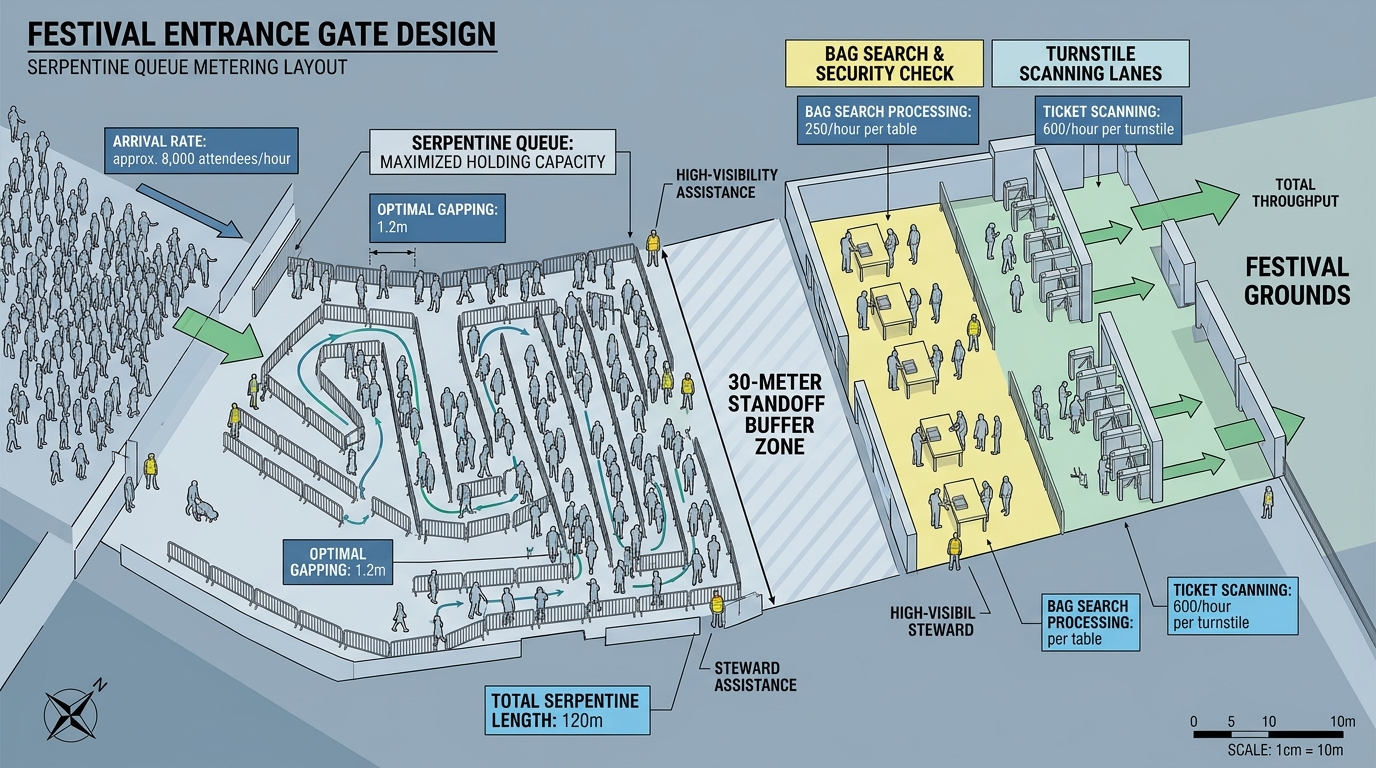
Allowing an arriving crowd to approach turnstiles in a direct, straight line creates an irresistible hydraulic vector: individuals at the back push straight ahead, and that kinetic energy transmits directly against the frontline scanning gates. To break forward momentum, crowd engineers deploy serpentine (zig-zag switchback) barrier layouts.
A compliant serpentine queue achieves three vital life-safety functions:
- 1. Kinetic Decoupling: Because attendees are constantly turning 180 degrees through switchbacks, forward pushing forces cannot accumulate. Energy dissipates laterally into the heavy interlocking steel barricades.
- 2. Controlled Density (Flow Singulation): Serpentine lanes with a clear width of 1.20 to 1.40 metres accommodate comfortable walking with backpacks or pushchairs while preventing aggressive patrons from overtaking two- or three-abreast.
- 3. Dynamic Buffer Storage: A switchback network holding 120 metres of linear run stores hundreds of arriving attendees in an orderly queue rather than leaving them in a chaotic exterior crush.
The 30-Metre Standoff Buffer Zone
A fatal error in site layout is running the serpentine queue directly into the turnstiles. The Purple Guide and HSG154 mandate a clear, open buffer zone of 25 to 30 metres between the exit of the serpentine queue and the turnstile portals.
This buffer zone serves as a “pressure relief valve”: high-visibility stewards stationed at the exit of the queue meter attendees forward into the buffer area in controlled pulses (e.g., 40 to 50 persons at a time). If a ticket scanner fails or a bag search stalls, stewards simply hold the queue exit; the turnstile area never experiences crowd pressure.
Managing Gate Holds: The 4-Phase Staged Reopening Protocol
Occasionally, ingress gates must pause mid-event: an electrical scanner network drops out, an unattended backpack requires police inspection, or a small flare is discharged in the entrance corridor. When gates close, arrival flow does not stop; thousands continue to arrive at the rear of the queue, building intense static head pressure.
When the incident clears, reopening all gates simultaneously is lethal. Attendees at the rear surge forward immediately upon seeing gates move, triggering an explosive crush against the front turnstiles—the exact failure mode analyzed in our Ghana Party in the Park incident analysis.
Venue safety teams must execute this mandatory 4-phase protocol:
- Upstream Visual & Audible Communication (T - 5 min): Before touching the gates, deploy stewards with megaphones 50 metres upstream into the crowd and trigger digital LED signage: “Gates will reopen in staged phases. Do not push forward.” Explaining the delay eliminates the information asymmetry that drives rear surges.
- Staged Pulse Opening (20% Capacity): Reopen only 2 out of 10 gates initially. Allow the immediate frontline attendees who were trapped against the barrier to pass through calmly.
- Controlled Queue Metering (50% Capacity): Once the frontline crush is vented, stewards stationed at the serpentine switchbacks pulse small groups through the 30-metre buffer zone.
- Full Ingress Restoration (100% Capacity): Open all remaining gates only after queue density indicators drop below 3.0 persons/m² and flow stabilizes.
Steward Staffing & Positioning Plan
Physical barriers only direct flow; trained personnel prevent crushes. An effective ingress deployment requires four distinct steward assignments:
- Queue Marshals (Upstream Filter): Stationed at the entrance of the serpentine maze. Their duty is to inspect tickets visually (ensuring patrons are in the correct gate queue), confiscate visible prohibited items (glass bottles, fireworks) before they reach the search tables, and answer attendee questions.
- Switchback Spotters: Elevated stewards positioned at the turning elbows of the serpentine maze. They monitor queue density, check for fallen items or trips, and open emergency escape gates if an attendee suffers heat exhaustion.
- Buffer Zone Regulators: Stationed between the queue exit and turnstiles. They regulate pulse-release rates to ensure search tables operate at 100% efficiency without overcrowding.
- Turnstile Monitors: Stationed immediately behind scanning gates to assist patrons with unreadable digital tickets and direct them to ticketing customer service booths without obstructing the flow lane.
You can calculate exact staffing requirements based on your projected attendee volume using our interactive Crowd Staffing Ratio Calculator.
Emergency Egress Gates Along the Queue Run
In accordance with Green Guide §9.6, a queue maze must never become a physical trap. If a panic trigger occurs (such as a firecracker, thunderstorm, or false alarm), attendees inside the serpentine railing must not be trapped in 100 metres of metal fencing.
Safety plans must incorporate outward-swinging emergency breakout gates positioned every 15 metres along the queue run. These gates must be held closed by quick-release pins or magnetic latches that stewards can strike open instantly, transforming the constrained serpentine maze into wide, open egress routes within five seconds.
Summary Checklist for Event Operations Directors
- Calculate peak arrival rate using the 70% in 90 minutes formula, not the total event hours.
- Provide sufficient bag-search tables to maintain a 2:1 or 3:1 ratio relative to ticket scanning lanes.
- Deploy heavy interlocking steel barriers in a serpentine layout with 1.20 m to 1.40 m lane widths.
- Enforce a minimum 25-to-30-metre open standoff buffer zone in front of turnstiles.
- Install emergency escape gates every 15 metres along the queue barriers.
- Brief all gate supervisors on the 4-phase staged reopening protocol before doors open.
For more operational templates, consult our sector-specific guide in the Festivals Playbook, or certify your event crew in gate safety through the online Festival & Crowd Safety Certificate.
Ready to get your crowd safety certificate?
Takes only 15 minutes. Instantly verifiable certificate. Aligned with Martyn's Law and international crowd safety standards.