Crowd safety training: what actually works (and what doesn't)
Most crowd safety incidents are preventable. The difference between venues that have problems and venues that don't usually comes down to one thing: whether the staff on the ground knew what to look for.
Key Takeaways at a Glance
Martyn's Law Aligned
Covers UK Section 12 regulations & crowd capacity guidelines.
Verifiable ID Credentials
Instant certificate verification for crew CVs and employers.
In June 2017, 22,000 people gathered in Piazza San Carlo in Turin to watch a Champions League final on a big screen. Someone set off a firecracker. The crowd panicked. In less than two minutes, a crush had formed that injured over 1,500 people and killed two.
The square had been used for public events before. There was a security plan. There were stewards. It still happened — because the people on the ground didn't have the knowledge to recognise what was building before it did.
That's the problem with crowd safety training as it's usually done.
The problem with most training
Most event staff training is about rules. Don't let people in without a ticket. Check the guest list. Call your supervisor if there's a problem. These are fine instructions — but they don't prepare someone to look at a crowd and see what's about to go wrong before it does.
The research on crowd disasters is consistent. Nearly every crush was predictable. There were signs — density building at a specific point, people near the front in distress, a blocked exit that nobody cleared, a single route carrying flows in both directions. Someone on the ground could see these things. They just didn't know what they meant.
What useful training actually teaches
Effective crowd safety training has three parts:
1. Understanding density. Most people have no intuitive sense of what 5 people per m² looks like — but that's roughly the point where crush risk starts to climb sharply. Train your staff to recognise it by feel, not just by number. Packed but still moving is different from packed and not moving. The second one is a problem.
2. Understanding human behaviour in crowds. In an emergency, most people run toward the exit they came in through — not the nearest one. They follow the people in front of them even when those people are heading toward danger. Understanding these patterns changes how a steward positions themselves and where they direct attention.
3. Knowing exactly what to do. Not a vague "raise it with your supervisor" — a specific sequence. Who to radio, what to say, what information to give. In the first 60 seconds of a developing crowd problem, the quality of the information passed up the chain determines everything that follows.
The difference training makes
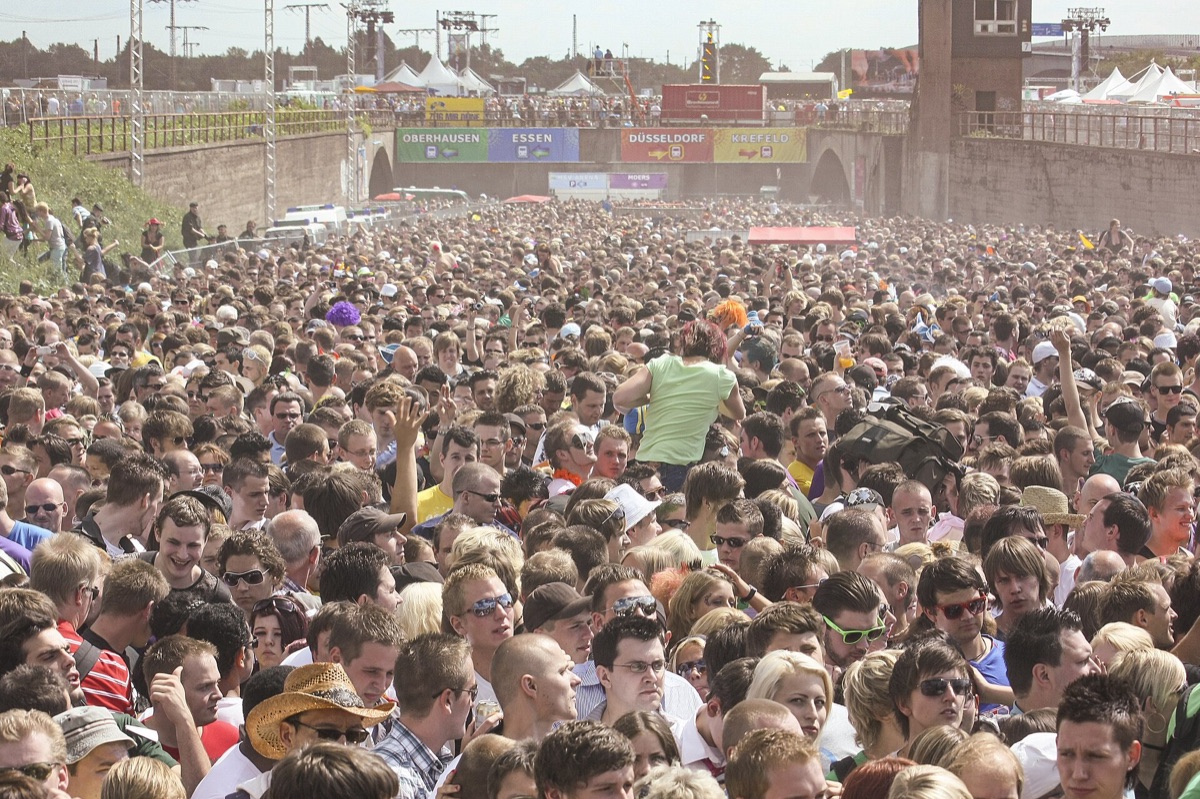
The Love Parade disaster in Duisburg in 2010 killed 21 people. The critical failure was a single tunnel used for entry and exit at the same time — a crossing flow that jammed solid. This is well-understood in crowd-safety literature. A trained steward would have flagged it in the site review.
At the Station nightclub fire in Rhode Island in 2003, 100 people died. Most tried to leave through the main entrance — the way they came in — while three other exits went almost unused. A briefed crowd would have been directed to the alternatives. Most weren't.
These aren't arguments for training as a legal formality. They're arguments for training that actually changes what a person does when they're standing in a packed venue at midnight and something starts to feel wrong.
What to look for in a training programme
A few questions worth asking:
- Does it explain why things go wrong, not just what to do? Understanding the mechanism makes the rules stick.
- Does it cover crowd psychology — how people actually behave under pressure, not how we assume they will?
- Is it scenario-based? Reading about crowd density is different from thinking through a real situation.
- Can the staff member prove they've done it? A verifiable certificate matters when you're demonstrating compliance to a licensing authority or an insurer.
Our Festival & Crowd Safety certificate is built around these principles — scenario-based questions, grounded in real disaster case studies, with a verifiable certificate at the end. It takes 15 minutes and covers what your staff actually needs to know.
If you want to see what goes into it before deciding, the full Safety Playbook is free.
Ready to get your crowd safety certificate?
Takes only 15 minutes. Instantly verifiable certificate. Aligned with Martyn's Law and international crowd safety standards.