Crowd Collapse and Compressive Asphyxia: Medical Physics, Force Dynamics, and Frontline Early Warning Signs
A technical analysis of crowd collapse mechanics, compressive asphyxia physics, Fruin density thresholds, and frontline steward extrication protocols.
Key Takeaways at a Glance
Martyn's Law Aligned
Covers UK Section 12 regulations & crowd capacity guidelines.
Verifiable ID Credentials
Instant certificate verification for crew CVs and employers.
- 1.The Medical Physics of Compressive Asphyxiation
- 2.Force Dynamics: How 4,500 Newtons of Force Accumulate
- 3.Fruin's Density Thresholds: From Flow to Fluid Lock
- 4.The Mechanics of Progressive Crowd Collapse (The “Void” Phenomenon)
- 5.Frontline Early Warning Signs: What Stewards Must Spot
- 6.Operational Interventions: How to Relieve Crowd Pressure
- 7.Conclusion: Moving from Reaction to Prevention
In mass gatherings, festival arenas, and stadium egress routes, few hazards are as catastrophic—or as widely misunderstood—as a progressive crowd collapse. In popular media and unverified reporting, mass casualty events in crowds are almost universally mischaracterized as “stampedes” or “trampling.” These terms imply that victims died because panicked individuals ran wildly over fallen bodies.
Forensic inquiries and biomechanical research tell a profoundly different story. In virtually every major crowd disaster in modern history—from the Hillsborough disaster in 1989 to the 2022 Itaewon alleyway crush—the overwhelming clinical cause of death was not blunt-force impact from trampling. It was mechanical compressive asphyxiation, where horizontal physical forces applied across a densely packed human mass prevent the ribcage from expanding. Crucially, victims frequently die while standing upright, held in a rigid vice by surrounding bodies.
This technical guide examines the medical physics of thoracic compression, empirical fluid-dynamic thresholds established by Dr. John J. Fruin (1971) and Prof. Keith Still (2014), the clinical timeline of asphyxia, and the frontline visual indicators that event safety stewards must recognize before lethal pressures develop.
The Medical Physics of Compressive Asphyxiation
Human respiration is an active biomechanical process. Inhalation requires the contraction of the diaphragm and intercostal muscles, which expands the thoracic cavity and creates negative intrathoracic pressure, drawing air into the lungs. Exhalation is largely passive as muscles relax.
In a severe crowd crush, lateral forces applied to the chest and abdomen alter this cycle irreversibly:
- Progressive Excursion Loss: When external pressure is exerted on the chest wall, an individual can exhale, but the surrounding physical mass immediately collapses into the void, preventing re-expansion. With each breath cycle, tidal volume decreases until pulmonary ventilation ceases entirely.
- Vascular and Venous Collapse: Sustained thoracic pressure compresses the superior and inferior vena cava. This dramatically restricts venous blood return to the heart, precipitating acute cerebral hypoxia and rapid cardiovascular collapse.
- Traumatic Flail and Petechial Hemorrhage: Autopsies conducted following crowd disasters (including Hillsborough and Itaewon) document extensive facial petechiae (pinpoint hemorrhages in the conjunctiva and skin), deep cyanosis across the head and neck, and fractured ribs resulting from unrelenting compressive force.
The Clinical Timeline: Seconds Count
The progression from severe compression to irreversible injury is exceptionally rapid:
- 0 to 30 Seconds: Tidal volume drops below critical thresholds. Restricted venous return causes acute lightheadedness, disorientation, and intense panic.
- 30 to 60 Seconds: Cerebral hypoxia induces loss of consciousness. The victim goes limp. In a standing crush, their body remains wedged upright by surrounding pressure.
- 2 to 4 Minutes: Severe asphyxia triggers cardiac arrhythmias, progressing to pulseless electrical activity (PEA) or asystole.
- 4 to 6 Minutes: Irreversible ischemic brain damage occurs. Even if pressure is relieved after this window, clinical resuscitation rates drop precipitously without immediate advanced airway management.
Force Dynamics: How 4,500 Newtons of Force Accumulate
Individuals in a crowd rarely push intentionally with homicidal force. The lethal forces measured in crowd disasters are the product of additive momentum. In his foundational text Introduction to Crowd Science (2014, CRC Press), Prof. Keith Still demonstrates how physical forces propagate across dense crowd cells:
A single person leaning forward casually can generate approximately 200 to 300 Newtons (N) of force. In an unmetered, unbroken crowd corridor containing several hundred people:
- Force Multiplication: As people in the rear lean forward or step into perceived open space, their force transmits directly to the bodies in front of them. In an unbroken column of only 5 to 6 persons, horizontal forces at the front reach 1,000 to 1,500 N (~225–340 lbs).
- Surge Amplification at Chokepoints: In deep standing fields (over 20 to 30 metres deep) without secondary delay barriers, momentum waves generated by minor shifts in the rear compound. Empirical measurements recorded during barrier load tests and incident postmortems demonstrate horizontal crowd pressures exceeding 4,000 to 4,500 N per linear metre (approx. 900 to 1,000 lbs) against structural barricades.
- Structural Failure: At 4.5 kN/m, crowd pressure is sufficient to buckle steel crowd barriers, bend 2-inch galvanized pipe railings, and collapse brick boundary walls—rendering human ribcages entirely defenseless.
Fruin's Density Thresholds: From Flow to Fluid Lock
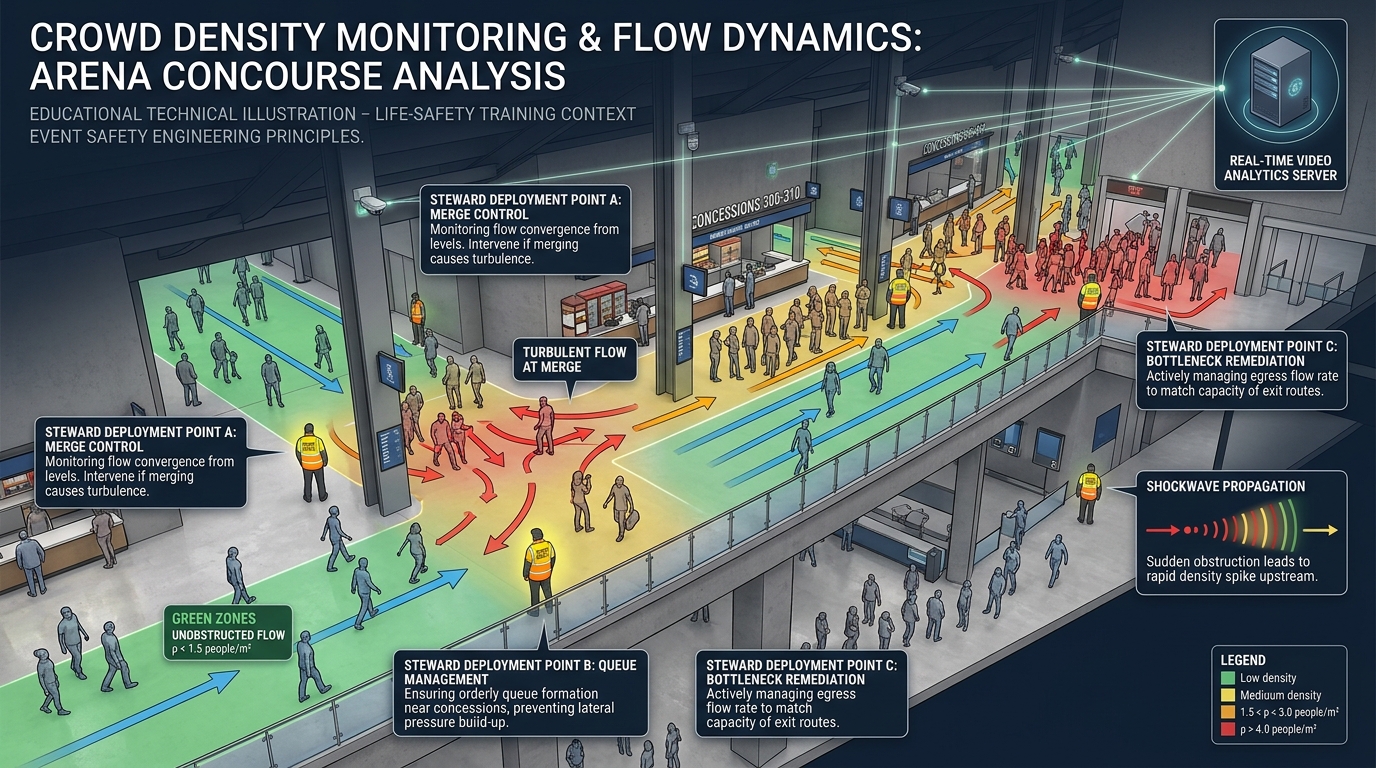
The progression from safe event flow to lethal compressive asphyxia follows distinct density phases documented in Dr. John J. Fruin's seminal work Pedestrian Planning and Design (1971) and synthesized in the UK Sports Grounds Safety Authority (SGSA) Guide to Safety at Sports Grounds (Green Guide, 6th ed., 2018, Section 2.5):
| Density (p/m²) | Physical State | Crowd Dynamics & Risk Level |
|---|---|---|
| < 1.5 | Free Flow | Unimpeded walking. Attendees can freely choose walking speed and bypass others without physical contact. Safe operating zone. |
| 2.0 to 3.0 | Restricted Flow | Walking speed declines noticeably. Passing is difficult. Normal concourse and queue density during peak ingress. |
| 4.0 to 4.5 | Critical Transition Zone | Continuous bodily contact. Attendees cannot adjust position without touching neighbors. Individual movement control begins to erode. Stewards must intervene to meter further inflow. |
| 5.0 to 6.0 | Shockwave Propagation | Extreme danger. The crowd transitions into a semi-fluid state. Minor movements generate pressure shockwaves that travel through the mass. Attendees are swayed involuntarily. |
| > 6.0 to 7.0+ | Fluid Lock / Lethal Crush | Bodies are compressed tightly together. Lungs cannot expand. Force transmission exceeds 4,000 N. Acute compressive asphyxiation occurs within 60 seconds. |
You can model how these square-metre limits apply to your specific venue footprint using our interactive Crowd Capacity Calculator.
The Mechanics of Progressive Crowd Collapse (The “Void” Phenomenon)
A secondary mechanism of injury in dense crowds is the progressive crowd collapse. In fluid dynamics, this is analogous to cavitation in pressurized pipes:
- The Trip or Syncope Event: In a crowd exceeding 5 persons/m², an individual slips, trips on discarded debris, or faints from heat exhaustion.
- Creation of a Void: As that person falls, a sudden pocket of zero resistance is created in the surrounding matrix of compressed bodies.
- The Involuntary Collapse: The individuals immediately behind—who were previously leaning against the fallen person to maintain balance—instantly lose their support. Driven by the forward momentum of the hundreds behind them, they fall forward into the void.
- The Structural Pile-Up: A cascade begins. Within 15 to 30 seconds, a pile of entangled bodies 3 to 5 layers deep (up to 1.5 metres high) accumulates. Those at the bottom are subjected not merely to lateral crowd pressure, but to hundreds of kilograms of vertical deadload, causing acute traumatic asphyxia and spinal injury.
This dynamic was central to the catastrophic casualties at the 2022 Itaewon crush, where a steep 4-metre-wide sloped alleyway triggered a multi-layer human collapse from which individuals could not be disentangled by emergency personnel without releasing upstream pressure first.
Frontline Early Warning Signs: What Stewards Must Spot
Waiting for attendees to shout for help before recognizing a crowd crush is fatal. One of the most counter-intuitive realities of crowd safety is that a crowd in lethal compressive distress is often eerily silent. When an individual's thoracic cavity is compressed under 4,000 N of force, they cannot inhale enough air volume to vibrate their vocal cords. Screaming is physically impossible.
Event stewards, pit security, and venue spotters must be trained to scan for four visual early warning indicators:
- 1. Inability to Raise Arms: When crowd density passes 4.5 p/m², people lose the ability to lift their hands to their chest or face. If an attendee's arms are pinned straight down against their hips or thighs, they are in the danger zone.
- 2. The “Gasping Pose” and Blank Gaze: Distressed patrons exhibit a distinct posture: head tilted backward, neck hyper-extended, mouth open gasping for air, eyes wide and unfocused, or eyes rolling upward.
- 3. Coordinated Involuntary Swaying (Shockwaves): When stewards observe rhythmic, wave-like oscillations rippling through a standing crowd—where groups of 20 to 50 people lean and sway as a single unit without moving their feet—the crowd has entered the fluid state. A collapse is imminent within seconds.
- 4. Facial Cyanosis: Bluish or dark purple discolouration around the lips, earlobes, and nail beds, indicating acute blood oxygen depletion from vena cava compression.
Operational Interventions: How to Relieve Crowd Pressure
When compressive indicators or shockwave turbulence appear, frontline teams must execute pre-drilled operational protocols immediately:
1. The Two-Person Barrier Extrication Lift
Pit stewards stationed behind front-of-stage barriers (compliant with IStructE 4th ed., 2017 and Purple Guide 2024) must operate in coordinated pairs from raised rear footboards. Steward A secures the patron under both armpits to protect the cervical spine, while Steward B supports the pelvis and lower torso. The individual is lifted smoothly up and over the 1.20 m top rail onto the platform before transfer to medical triage. Single-person lifts risk dropping the casualty back into the high-pressure zone.
2. Activating Lateral Pressure-Relief Corridors
Never attempt to push a surging crowd backward from the front with force—this merely compresses the front rank against opposing forces. Instead, safety coordinators must open pre-planned lateral pressure-relief gates (flanking gates leading into open concourses or side yards) to allow the crowd to vent outwards, rapidly dropping square-metre density below 4 p/m².
3. The Immediate “Show-Stop” Procedure
Every event safety plan must designate a specific individual with absolute, contractual authority to halt the performance. The sound engineer immediately cuts front-of-house PA music, the lighting director raises house lights to 100% white, and the stage manager or artist gives a calm, direct public address instruction: “Everyone, please stop moving forward. Take three big steps backward right now to give space to your neighbors.”
Conclusion: Moving from Reaction to Prevention
Compressive asphyxiation in assembly venues is neither an unpredictable act of nature nor the result of collective attendee panic. It is the deterministic physical outcome of exceeding spatial carrying capacity and failing to meter flow through chokepoints. By understanding the fluid mechanics of human crowds and equipping frontline staff with the training to recognize silent compressive distress early, venue operators can prevent near-misses from turning into fatalities.
Learn how to calculate safe occupancy and egress parameters with our free Exit & Evacuation Calculator, or certify your venue stewards through our accredited online Festival & Crowd Safety Certificate.
Ready to get your crowd safety certificate?
Takes only 15 minutes. Instantly verifiable certificate. Aligned with Martyn's Law and international crowd safety standards.